Turkish checkers (Dama) strategy: how to win more
To get better at Turkish checkers (Dama), learn to use the compulsory capture rule: your opponent must capture, and must take the most pieces possible, so by giving up a piece at the right moment you decide where their capturing piece will land. Add a compact formation, careful timing of every advance and a clear plan for your first king, and you will win many more games than you lose.
Think in straight lines
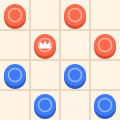
In Dama the pieces move straight forward and sideways, never diagonally, and all 64 squares are in play. That changes how you read the board: the danger comes along rows and columns, and a single open row can be all an enemy king needs.
Men never move backwards. Every forward step is permanent, and a man that has run past the enemy pieces can no longer come back to help defend. Before you advance, ask whether you will still want that piece behind you a few moves from now. Sideways moves are your way to adjust without giving up ground.
Make the compulsory capture work for you
Because capturing is compulsory, and the longest capture must be chosen, you can often decide where your opponent’s piece will land. Give up one piece, and the capturing piece ends up on a square where you take two or three back. This is the heart of Dama tactics.
The same rule works against you, so check every move with these questions:
- Which captures does this move allow my opponent?
- Which of them is the longest, since that is the one they must play?
- Where does their piece stand after that capture, and what can I take then?
Keep your pieces close together
Every capture needs an empty landing square right behind the piece being taken, in the direction of the jump. A man with a friend directly behind it cannot be captured from the front, and a man with a friend beside it cannot be captured from the other side.
So move in pairs and small blocks, and close gaps as soon as they appear. A man that has run ahead on its own is the easiest target on the board: it can be surrounded, and once it is lost, the hole it leaves often opens the next capture. When you must leave a gap, make sure your opponent has no piece that can use it next move.
Count your spare moves
A step forward can never be taken back, but a step sideways can, as long as there is room. In a closed position the real question is how many safe moves each side has left: once neither a sideways move nor an advance is safe, the player to move has to give up a piece. Keep a free square beside some of your men so you always have a quiet move in reserve, and try to take that room away from your opponent.
A quiet sideways move in your own half can be worth more than an advance, because it keeps your formation intact and passes the problem back to your opponent. And remember the extreme case: if your opponent has no legal move at all, you win the game.
Win the race to the first king
A king moves any distance along a row or column and captures from far away, so the first king usually decides the game. Prepare a path for one of your men on a side of the board where your pieces outnumber your opponent’s, and support it so it cannot be captured on the way.
At the same time, guard the rows nearest you. Do not empty them too early: a man there can still slide sideways to block or capture an enemy runner. A man that reaches the last row in the middle of a multiple capture keeps capturing as a man and is crowned only when the move ends, so count that sequence to its end.
Playing with kings and against them
In a capture sequence, each captured piece is removed at once, so a king can cross the same square again later in the same move. It can also land on any empty square beyond the piece it jumps, which lets it choose where the next capture starts. One rule to keep in mind: no piece may turn straight back the way it just came.
To defend against a king, keep rows and columns closed and your men in pairs along them, so it never finds an empty square behind a piece. When you are ahead, keep pushing men towards the last row instead of shuffling kings: on EwrekaGames, 60 king moves in a row without a capture end the game in a draw, and so does a position with one king on each side.
Questions about getting better
Why do I keep losing two pieces for one?
Usually because a move left an empty square behind one of your pieces, and the forced capture rule did the rest. Before each move, look at every capture your opponent could make afterwards and follow the longest one to its end: that is the one they have to play, and the one they can plan for.
Should I trade pieces when I am ahead in Dama?
Generally yes. With fewer pieces on the board, an extra piece matters more, and your opponent has fewer chances for combinations. Trade in ways that keep your formation compact, and keep at least one man moving towards a king, because a single king against a single king is a draw.
How do I stop an opponent who already has a king?
Close the open lines. Keep your men next to each other along rows and columns so the king finds no empty landing square behind them, and avoid lone pieces it can pick off. Then race for a king of your own as quickly as you safely can.