Backgammon strategy for beginners
To get better at backgammon, judge every move by the position it leaves, not by how far it takes you. Make points instead of scattering single checkers, hit when it costs you little, and decide early whether you are racing or fighting. Check the pip count every few turns, and when you bear off, clear your highest points first so you leave no shots.
Look at every way to play the roll
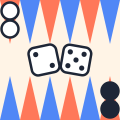
Before you touch a checker, find two or three different ways to use the dice and compare them. The checkers you can move light up; choosing between them is your job.
Three questions sort out most rolls. Can I make a new point? Can I hit a single opposing checker? Which of my checkers will be left alone, and how many rolls hit them? Remember that you have to use both dice when you can, and the larger one if only one fits. Sometimes the move you wanted is not allowed, so check the whole roll before committing to the first half.
Make points, starting in your home board
Two or more of your checkers on a point make it safe and block your opponent from landing there. The most valuable points are the ones in your home board and the point just in front of it, because a hit checker has to come back in through your home board. Every point you hold there takes away entry numbers from your opponent.
From the starting position, some rolls make a strong point at once: 3-1 makes your 5-point with checkers from the 8-point and the 6-point, 4-2 makes your 4-point, and 6-1 makes the point just outside your home board. Points in a row matter even more: three or four already hinder a back checker, and six in a row cannot be jumped at all.
Blots: when the risk is worth it
A single checker on a point, a blot, can be hit. How risky it is depends mostly on distance. With no points in the way, a blot six points in front of an opposing checker is hit by 17 of the 36 possible rolls, while one seven points away is hit by only 6, because it needs both dice combined.
So leaving a blot is not always wrong. Early in the game a hit costs you only the few pips the checker had travelled, so splitting your back checkers can pay off. Near the end it is the opposite: a checker hit just before reaching home has to go all the way round again. When the opponent already holds several points in their home board, play safe.
Race or fight: use the pip count
The pip count on screen shows how many points your checkers still have to travel and how many your opponent’s do. Lower is better. When you are clearly ahead, get your back checkers out and break contact; once the two sides have passed each other, nobody can be hit and the game is a pure race.
When you are behind, a race only loses slowly. Keep a point in your opponent’s home board, an anchor, so your back checkers are safe, and wait for them to leave a shot as they bring their checkers in. Also keep the score in mind: a gammon is worth 2 points here, so when you are losing badly, bring everything home and bear off at least one checker to lose only 1.
Bear off without leaving shots
Once all 15 checkers are in your home board, you bear off. A die that matches a point takes a checker off from that point. A higher die can take a checker off the highest occupied point, but only if no checker of yours sits further back. If the die is lower than the point, that checker can only move inside the home board.
In a pure race, take a checker off with every die you can. While your opponent still has a checker in your home board or on the bar, slow down and play safely:
- Clear your points from the back, starting with the 6-point, rather than leaving gaps.
- Keep an even number of checkers on your highest points, so a single die cannot leave one alone.
- If every play leaves a blot, leave it where the fewest numbers hit it.
Questions about getting better
Should I always hit when I can?
No, but usually. Hitting sends a checker back to start and costs your opponent part of their next turn. Skip the hit when it leaves you open to a return shot against a strong home board, or when a safe point-making move does more for your position.
How do I know if I am winning the race?
Compare the two pip counts. A single roll moves a little over 8 pips on average, so a lead of about 8 pips is worth roughly one whole roll. Having the next roll is an advantage too, so a small lead for the player about to roll counts for more.
Is backgammon more luck or skill?
The dice decide many single games, which is why beginners can beat strong players now and then. Over a series the better player wins more often, because good moves keep turning average rolls into better positions. Points add up across rematches here, so play a series.
Why do my back checkers keep getting trapped?
You are probably waiting too long to move them. Split them or run with them early, while your opponent’s home board is still open. Once your opponent has four or five points in a row in front of them, it is often too late.